

Shipping a product on an open model without reading the license is how you get a cease-and-desist. The practical way to read licenses at scale is inside a database: run an open source LLM benchmark database search across the catalog, group the models by license family, and two patterns jump out. First, the families are wildly uneven in size. Second, they are just as uneven in how much proof they publish. Both patterns matter when the model has to earn money, because a license you cannot verify and a score you cannot find are the same kind of risk.
License families, counted, with their proof
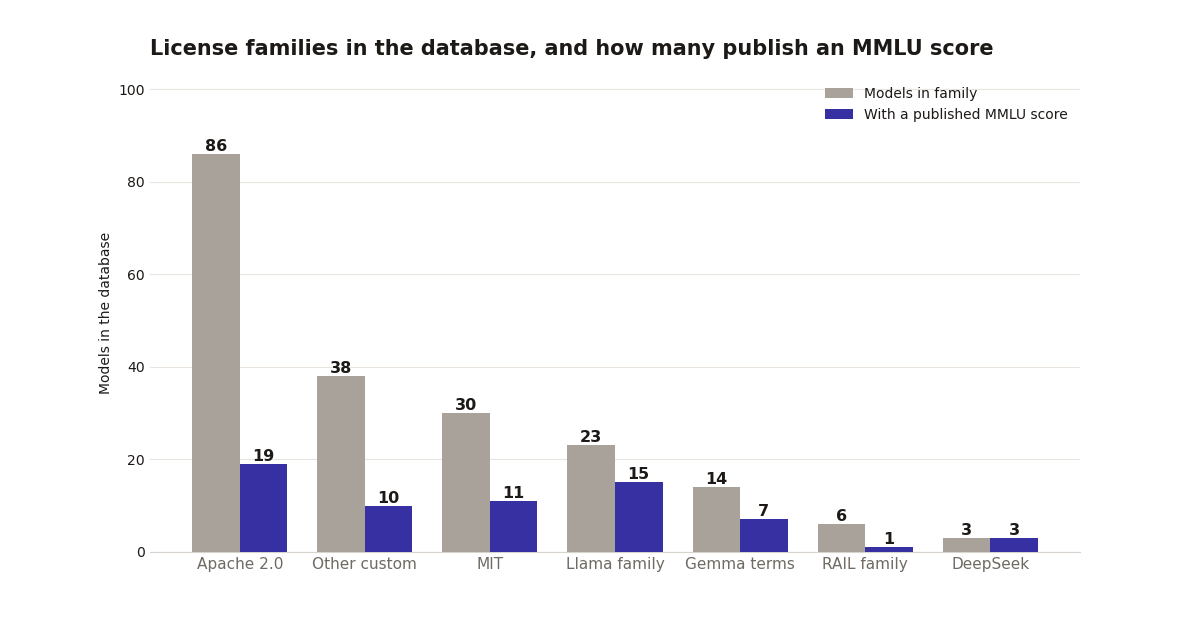
Across 200 models from 30 developers, Apache 2.0 is the default setting of the open model world: 86 models. MIT adds 30 more, so 116 of the 200 carry one of the two classic permissive licenses. The Llama family accounts for 23 models across its 3.x releases, Gemma terms cover 14, the RAIL family 6, DeepSeek just 3, and 38 models sit under assorted custom terms. Now the proof column. Only 66 of the 200 models publish an MMLU score at all. DeepSeek publishes for all 3 of its models and the Llama family for 15 of 23, but Apache 2.0, the biggest family, publishes for only 19 of 86. A database view that puts the license and the score side by side stops you from mistaking a big family for a well-documented one.
The second proof column tells the same story. HumanEval, the coding benchmark, is recorded for only 45 of the 200 models, and just 36 models publish both scores. The RAIL family, only 6 models, publishes a HumanEval score for every one of them, and DeepSeek does the same for its 3. At the other end, the 38 custom-license models publish a HumanEval score just 3 times between them. Custom terms plus missing scores is the worst combination in the catalog: the hardest licenses to read belong to the families with the least public evidence about quality.
The four licenses that matter
1) MIT (Phi-4, many small models): do almost anything, just keep the copyright notice. The simplest green light. 2) Apache 2.0 (Qwen3, Mistral 7B): commercial use allowed, includes a patent grant, keep notices and note changes. Also a green light. 3) Llama Community License (Llama 3.x): commercial use allowed, but Meta can revoke rights above 700 million monthly users, with acceptable-use restrictions. Fine for most companies; read the fine print. 4) Gemma Terms of Use (Gemma 3): Google's custom terms, commercial use allowed with use restrictions, not OSI open source. Also check DeepSeek's license per release, it has changed.
When in doubt, Apache 2.0 or MIT models remove the question entirely, and the counts above show how much choice that leaves: 116 models, 30 of them with a published MMLU score to check quality against. Screenshot the license file the day you ship, so you have a record of the terms you agreed to.
None of this means the big permissive families are a free pass. Apache 2.0 and MIT together cover 116 models, yet only 17 of them publish a HumanEval score, so most permissive models still need a local evaluation before they carry a product. The license removes the legal question, not the quality question. Budget an afternoon of testing for any model you ship, whatever family it comes from.
Search the database before you ship
Start with fit: the Will It Run? checker filters the same 200-model database by your RAM and VRAM, so the models on your shortlist are ones your hardware can actually serve. Then run the license pass from this page over whatever survives the fit check. Fit first, terms second, and the shortlist you ship from has no surprises left in it: nothing that will not run, and nothing you are not allowed to sell.
Related reading
The score side of the same database is ranked in Both Scores, Ranked: The 36 Models With an MMLU and a HumanEval, Split by License. For the terminology behind the families, see Open Weight LLM Models List: What 'Open Weight' Really Means, and for reading scores skeptically, LLM Benchmark Scores Comparison: Why One Number Never Tells the Story.
Sources: Hugging Face | Ollama