Most local AI releases this year chased bigger. NVIDIA's newest goes the other way. On October 23, 2026, NVIDIA released Nemotron 3.5 Bolt E4B 4GB, an open small language model built from Google's Gemma 4 E4B with NVIDIA post-training, designed for conversational agents that live on the device itself: voice and device assistants, interactive characters, and robotic and IoT interfaces. The pitch is in the name. The agent gets about 4 GB, and the rest of the machine stays yours.
What shipped
Bolt E4B is an 8B parameter model with 4B effective parameters, post-trained by NVIDIA from Gemma 4 E4B it with reinforcement learning aimed at conversation, instruction following, and multi-turn tool use. The release ships a Q4_K_M GGUF checkpoint, a full BF16 checkpoint, and companion DFlash drafter models for speculative decoding. The headline features, per NVIDIA: multi-turn tool calling across a conversation, a conversational mode that keeps replies short and speech-ready, configurable reasoning you can switch off or cap to hold a latency budget, a 64K token context, and support for 35 languages. NVIDIA targets GeForce RTX cards, Jetson boards, and its RTX Spark and DGX Spark systems. The Hugging Face card lists the license as OpenMDW-1.1 and states the model is ready for commercial or non-commercial use; the Gemma 4 base underneath remains under Apache 2.0.
The 4 GB is a workload, not a promise
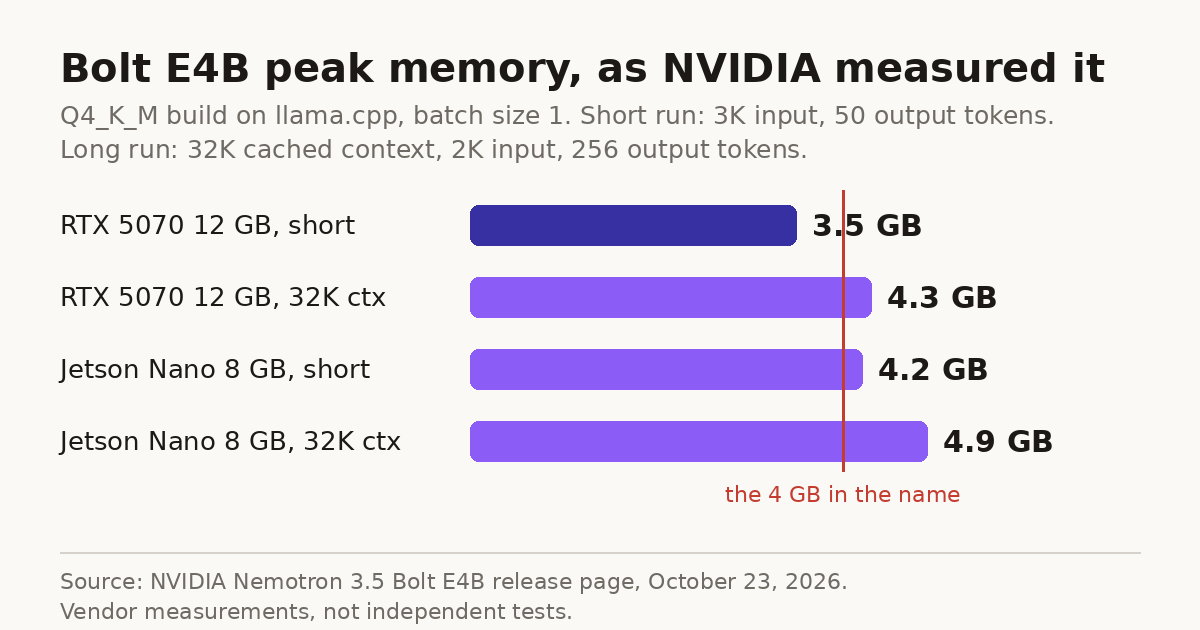
NVIDIA published peak memory figures for the Q4_K_M build on llama.cpp, batch size 1, and they are worth reading row by row, because the name only survives some of them. Short conversational turns, 3K input tokens and 50 output, peak at 3.5 GB on an RTX 5070 and 4.2 GB on a Jetson Orin Nano 8GB. Give the same model a 32K cached context with 2K of new input and the numbers climb to 4.3 GB on the RTX 5070 and 4.9 GB on the little Jetson. A larger Jetson AGX Orin tops the published table at 5.0 GB. These are NVIDIA's own measurements, not independent tests, and NVIDIA says as much itself: results vary with hardware, inference software, and configuration.
| Hardware | Workload | Peak memory |
|---|---|---|
| RTX 5070 (12 GB) | No cache, 3K in, 50 out | 3.5 GB |
| RTX 5070 (12 GB) | 32K cache, 2K in, 256 out | 4.3 GB |
| Jetson Orin Nano (8 GB) | No cache, 3K in, 50 out | 4.2 GB |
| Jetson Orin Nano (8 GB) | 32K cache, 2K in, 256 out | 4.9 GB |
The honest read: the 4 GB name is a design target for the short, snappy exchanges a voice assistant actually has, and on a desktop card it holds with room to spare. Long conversations carried in a big cached context are a different workload, and on an 8 GB board they eat most of the device. Plan against the row that matches your context length, not the row in the product name.
Why the bottom end is a different problem
A chat window forgives a slow first token. A voice assistant does not: the person is standing there, mid-sentence, waiting. Conversational agents are latency-bound and always on, and on a real device the language model shares memory with speech recognition, speech synthesis, maybe a vision model, and the app itself. That is why NVIDIA designed Bolt E4B to interleave dialogue with tool calls while preserving headroom for the rest of the pipeline, and why the reasoning toggle matters at this size: thinking can be capped or switched off entirely when the latency budget says so. Whether it holds up in your product is a separate question. NVIDIA reports roughly 40 percent higher average quality than its prior model on its own conversational agent benchmarks, with up to 80 percent fewer output tokens; treat those as the vendor's numbers on the vendor's harness until independent tests land.
Where to get it
The weights are on Hugging Face, and NVIDIA lists day-one routes through Ollama, LM Studio, Unsloth, Canonical, and the Jetson AI Lab, plus its In-Game Inferencing SDK for game characters. If you already run one of the desktop companions, the model arrives inside a tool you know; our Ollama vs LM Studio vs Jan comparison covers which companion suits which style of work.
Three checks before you adopt it
First, test it at your real context length. The gap between the 3K row and the 32K row is the whole story of this release, and your users will live in one of them. Second, know that our own checker cannot clear this model yet. Bolt E4B is not in the PrivateAIAgent dataset, whose 200 records were last verified on September 14, 2026, and it is not in the data behind Will It Run?, harvested on October 22, 2026, so the tool will not list or rank it. For the models it does cover, the checker stays the fastest fit test we know: two checks a day are free on your connection, then an email unlocks unlimited checks for the rest of the day. The method behind it is in our seven checks before you download a model. Third, read the license yourself. OpenMDW-1.1 is a different document from the Apache 2.0 that covers the Gemma base, and the card's terms are the ones that govern your use.
Small models used to mean settling. A tool-calling agent that answers out loud, on the device, inside 4 GB at conversational lengths is a different category of thing, and it is the category most products actually need. Start with the context row that matches your app, then pick the companion to run it in.