
A confession that should be printed on every leaderboard, including ours: the benchmark scores in the PrivateAIAgent dataset are reported, not run. Each figure is the number the model's publisher published, recorded by us with a source and a verification date. We operate no benchmark harness. That single fact changes how every number on this site should be read, and this page exists to make the reading honest, using evidence from our own table.
The reason independent benchmarks exist at all is contamination. MMLU's questions have circulated publicly since 2020. A model trained on enough of the public web can meet the test's questions, or near copies of them, during training, and its score then measures memory as much as ability. LiveBench, the benchmark built around this problem, answers it with fresh questions released on a schedule, so the test cannot have leaked into training data that predates it. Static leaderboards, ours included, have no such protection, and their numbers should be discounted accordingly.
Three tells in our own table
The identical figure. Three different Llama models in our dataset, the 405B base model, the 405B Instruct and the 3.3 70B Instruct, record exactly the same HumanEval score: 89.0. Three distinct models do not naturally land on the identical tenth of a point. That is the signature of a family-level figure published once and recorded against each variant, which is what reported data looks like from the inside.
The moving name. DeepSeek R1 appears twice in the dataset, at 90.8 MMLU for the original release and 91.4 for the refreshed 0528 version. A score belongs to a version, not a name, and a leaderboard that does not date its rows quietly mixes generations.
The blanks. Of the 200 models we track, 125 carry no benchmark score of either kind and 75 carry exactly one. The blank rows are not the worst models. They are the least reported ones, often older or from smaller teams. Absence of a score is information about a publisher's reporting, and treating it as a zero is the single most common misreading of any leaderboard, including the MMLU ranking on this site, which is why that page shows blanks as blanks.
How to read a row on this site
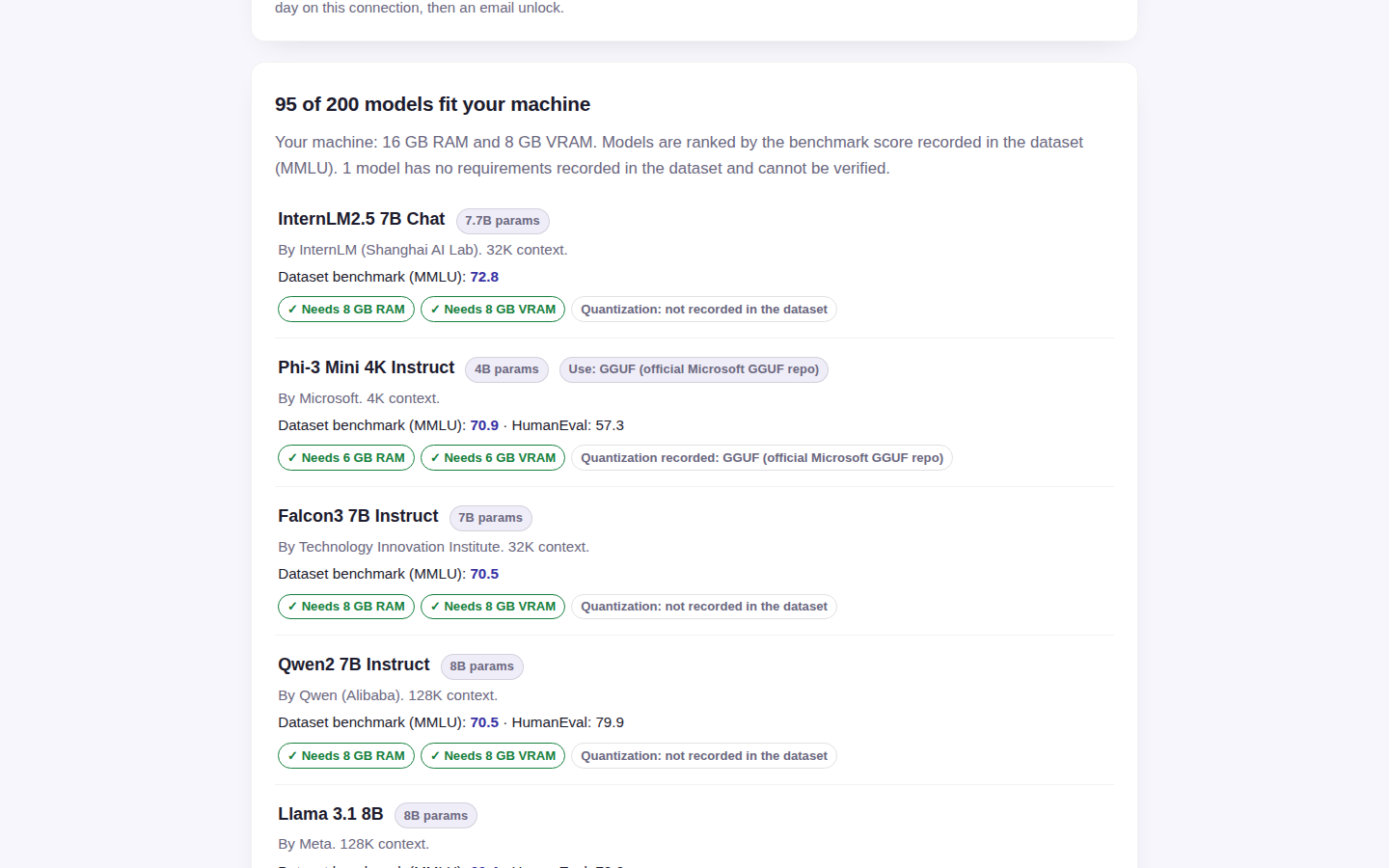
Four conventions, stated once. A score is the publisher's reported figure as recorded on the model's record, with its source kept on file; it is a claim we transmit, not a measurement we made. Parameters are total billions, so mixture-of-experts models show their full total rather than their active count. The hardware figures are formula estimates computed from parameter counts, not measured requirements, and the dataset's RAM estimate equals its VRAM estimate on every row, a simplification you should know about before planning a purchase around them; the VRAM checks article works through what to verify. And every record carries a last verified date, because a score recorded in 2024 describes a 2024 model even when the name is still current.
What to do with a score, then
Use scores the way careful leaderboards say to use theirs: as a shortlist, not a verdict. Rank by the benchmark that matches your work, using the MMLU leaderboard or the both-scores ranking, then apply the two filters a score cannot see: whether the license permits your use, and whether the model fits your machine, which the Will It Run? checker answers from the same records. A reported score is a reasonable place to start and a poor place to stop. The companion argument, that even a perfectly measured single number would still not settle the choice, is in why one number never tells the story.