
Serious leaderboards document themselves: Artificial Analysis publishes a methodology page, and BenchLM labels every figure Supported or Estimated. This page is ours. It states where the numbers behind this site's leaderboards come from, how much of the field each number actually covers, and which figures are estimates rather than measurements.
Coverage, field by field
| Field | Models with a value | Source |
|---|---|---|
| Context window, parameters, release date | 200 of 200 | Publisher specifications |
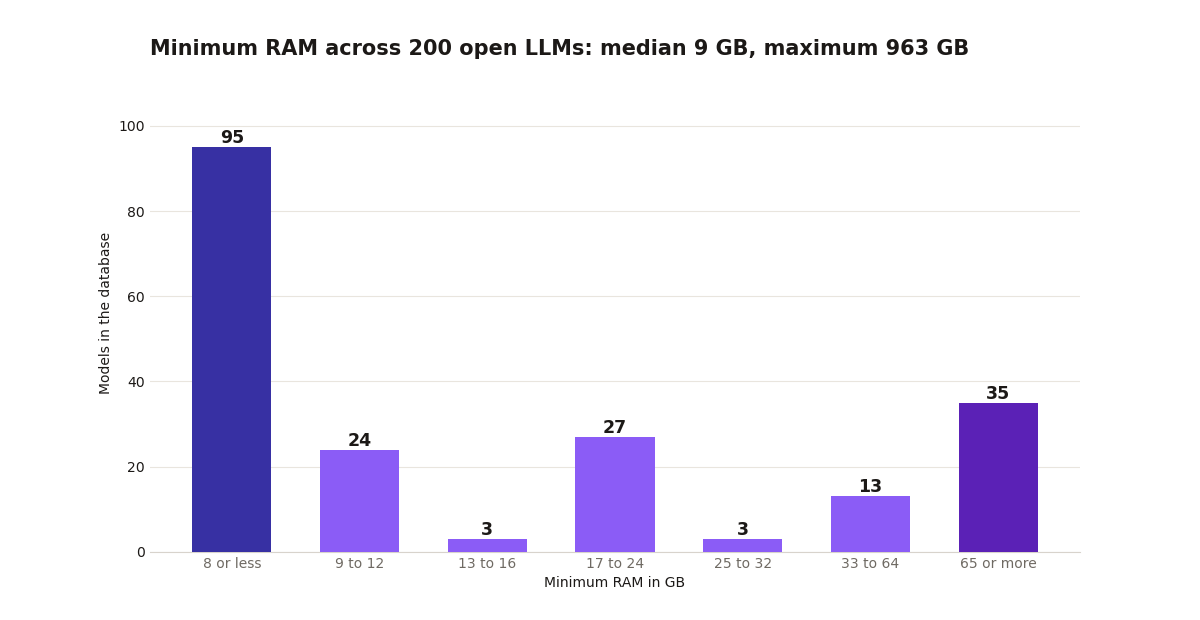
| Minimum RAM and VRAM | 200 of 200 | Our formula estimate (see below) |
| MMLU score | 66 of 200 | Reported by publishers and model cards |
| HumanEval score | 45 of 200 | Reported by publishers and model cards |
| Both scores | 36 of 200 | Reported |
| Neither score | 125 of 200 | Nothing published we could find |
| Official quantization published | 49 of 200 | Publisher repositories |
The three honesty rules
Reported, not run. We do not execute benchmarks. Every score is the figure its publisher reported, which is why our reading guide warns that identical scores across sibling models usually mean a copied figure. Estimates wear a label. RAM and VRAM minimums are computed from parameter counts and quantization formats, not measured on hardware; treat them as planning figures. Missing means missing. A model with no MMLU in our table has no score we could source, not a zero. The leaderboards rank only the models a field actually covers, and each one says how many that is.
Two more fields deserve a note. License is recorded for 199 of the 200 models (one record states no license we could verify), under 40-plus distinct license labels once spelling variants are counted, which is why our license splits group them into families. And the snapshot is a snapshot: models are added by their publishers faster than any static dataset updates, so coverage percentages describe September 2025, not today. A methodology page that hides its date is hiding its main limitation.
The dataset snapshot behind these pages was collected in September 2025. The Will It Run? checker uses the same records, estimates included, and says so on its results.
Sources: Artificial Analysis methodology and BenchLM's Supported versus Estimated evidence labels (the forms modeled here); this site's dataset of 200 open models, collected September 2025.